Investment Outlook for the Coming Months: Navigating Uncertainty
“I know that I know nothing!”
I begin every New Year with this or a similar sentence. It is pointless to comment on index targets or the development of currencies and regions. Therefore, we will not do so at the beginning of 2026 either.
People who invest usually do so with the motivation of keeping their money safe, maintaining purchasing power, or achieving realistic growth. Of course, there is also the motivation to speculate or to be proven right with a certain opinion, but that is not the focus of our work.
We want to help you achieve your (realistically defined) savings and investment goals with a high degree of certainty.
The Fundamentals: Valuation and Inflation
If you keep this in mind, you will realise that long-term investments, regardless of the current economic and political situation, always depend on the valuation of individual assets, the inflation rate, and the monetary policy of major central banks.
We know all these parameters today and can provide you with the necessary tools to take the right decisions. We have summarised these in the so-called high-rise charts on pages 12, 13, and 14 of this publication.
Your contribution consists primarily of taking a close look at your current and future cash flows to determine which of your assets are needed quite quickly and which of your assets can be stashed away for the long haul. That is because funds that are needed in the short term should not be invested in risky and highly volatile investments.
In contrast, funds that you are very likely to be able to set aside for more than 10 years should be invested in the most profitable investments, even if these investments are associated with high volatility in the short term.
Current Valuations: Safety vs. High Return
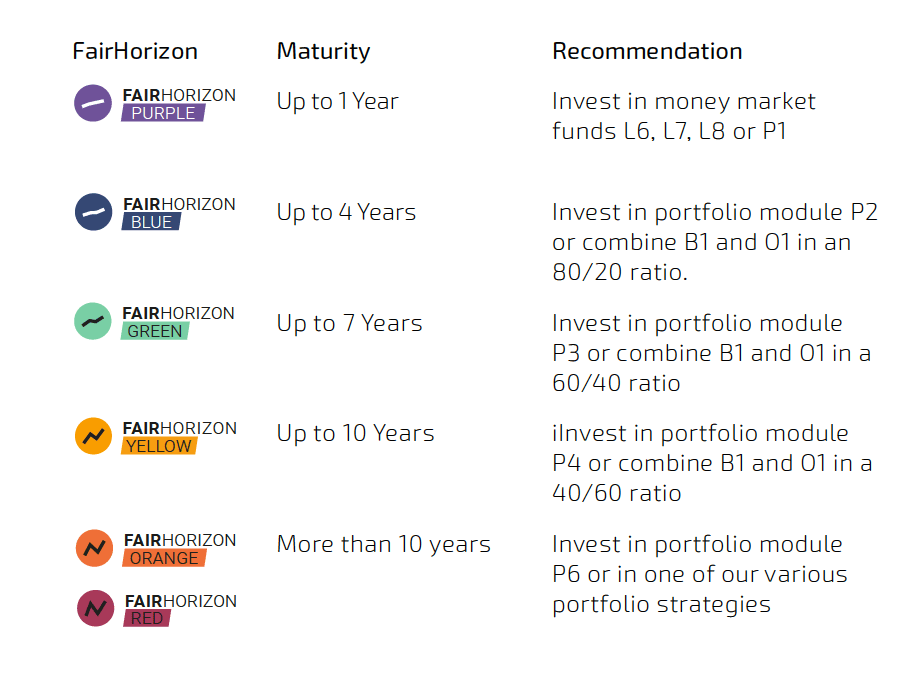
If we look at the current valuations of our high-return and safety investment ideas, we are pleased to see that the currently expected returns on our safety components are all exceeding the expected medium-term inflation rate, regardless of their investment horizon (FairHorizons purple to green). Even money market investments are close to current inflation rates and therefore offer purchasing power preservation. This was not the case in the years prior to the adjustment of global interest rates in 2022.
Regarding the high-return components that we select for longer-term investment horizons (Fair Horizons yellow to red), we always communicate a minimum target return of 6% p.a. or a projected long-term return of between 6% and 8% p.a.
Due to the positive performance in 2025, the current target returns (or risk premiums) of many high-return components are now below 6% p.a., which is why we would not be particularly enthusiastic about buying them at present valuations. This applies to the Nasdaq 100 Index and, to a lesser extent, the S&P 500 and the MSCI World Index.
Where We See Opportunity in 2026
The MSCI AC World IMI Index, which also includes small and emerging market companies, is once again close to a 6% risk premium and therefore more suited for new investments. Equities in Europe, Asia, and developing countries show risk premiums (i.e. target returns) of between 7% and 8% p.a., which is very comforting.
The current valuation of “our losers” of 2025—i.e., real estate stocks (REITs), quality factor index ETFs and quality managers, the healthcare sector, and listed private equity companies—can be considered attractive to very attractive. We would therefore like to take a closer look at these investments, which offer promising long-term prospects but have been disappointing in the short term. This makes them potential bets for 2026.
Commodities: The Case for Mining ETFs
As for the current enthusiasm for precious metals and copper, we have decided to include ETFs that invest in the relevant mining companies in our advisory universe.
We are not actually fans of highly “emotional” investments such as gold and Bitcoin, which are difficult to value, but we cannot deny that there is a changed global landscape. Since we do not know what will happen to the price of gold, silver, and copper in 2026, but do know that mining companies are currently generating a great deal of free cash flow that can be used for dividends and share buybacks, we are comfortable with these investments.
In addition, the risk premiums for the mentioned index ETFs are around 6-7% p.a., which seems sufficiently attractive. We would therefore prefer an investment in mining ETFs to a direct investment in gold or silver. In general, we consider the addition of commodities via broadly diversified indices or funds to be legitimate, but would not want to exceed a portfolio allocation of 10-15% in commodities.
Sector Spotlight: Clean Energy & Technology
Next, I would also like to mention an index that invests, so to speak, in the shovels and picks of the world’s new energy supply. This is the Nasdaq Clean Smart Grid Index, which can be easily purchased as an ETF from First Trust under the ticker GRID (R73-1).
The index has been calculated since 2009 and includes global companies that represent a sustainable and healthier energy supply. In contrast to many poorly structured indices reflecting the “clean energy sector”, this is a portfolio of established and sustainably profitable companies, all of which are market leaders. The index is currently valued at a risk premium of around 6% and has clearly outperformed the MSCI AC World IMI and the MSCI World Index since 2009. I consider it a good investment for investors who are looking for sustainable investments but do not want to sacrifice returns.
Anyone interested in the technology sector despite all the current valuation discussions should look at Paul Wick, the manager of the CT Global Technology Fund. He has proven since the mid-1990s that he is capable of successfully investing in technology stocks outside of the Magnificent 7. He has managed to beat the Nasdaq 100 Index, which is very difficult to achieve.
Currencies and Investment Styles
As far as currencies are concerned, we also do not know what the new year will bring. However, if we look at the DXY Index, which primarily reflects the relationship between the USD and the EUR, a certain stabilisation seems to be emerging. We therefore suspect that the dollar weakness of 2025 will only spill over into the new year to a limited extent. That said, a strong recovery of the U.S. dollar also seems hard to fathom at this stage.
As far as our three preferred investment styles are concerned, we can only emphasise that all three strategies work in the long term, even if they may disappoint in the short term. Investors should therefore stick to their chosen investment styles and not change them out of short-term disappointment. For example, an investor who purchased the Polar Biotech portfolio in late 2024 would have seen a very disappointing development until April 2025, followed by a massive rally of almost 100% into year-end.
Patience pays.
In this context, we are also thinking of the poor performance of the quality factor in 2025, which could perhaps reverse in 2026 because risk premiums have now risen back above 5% p.a., and the dollar weakness of the previous year should no longer have such a strong calculation effect for non-U.S. dollar investors.
Asset Allocation: The FairHorizon Framework
We generally recommend indexing for money market investments, active management for most bond strategies, and a mixture of indexing and stock picking for equity investments. We do this ourselves and feel good when we see the results.+1
For “fresh money,” we recommend our proven FairHorizons, which we have developed based on established asset allocation principles. It offers a simple way of creating portfolios beating inflation and earning attractive risk premiums.